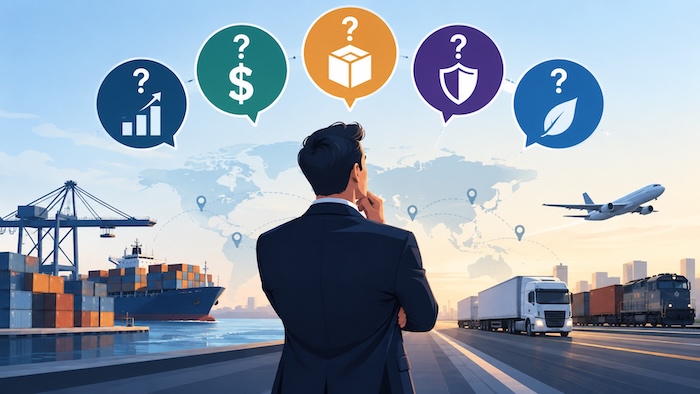
Transportation is one of the most dynamic parts of the supply chain… and it’s not easy. Changing market conditions and customer expectations, coupled with ongoing cost pressures, mean strategies that worked a year ago may no longer deliver the same results.
Paul Brinkman, President of Trans-Solutions Consulting, shared five questions supply chain leaders should be asking now to uncover hidden costs, reduce risk, and build more resilient transportation strategies.
1. Are you measuring total transportation cost, or just the freight rate?
People naturally gravitate toward the freight rate because it's easy to compare, but that’s a common misconception about “cost” because it's only one piece of the whole picture.
You can negotiate a great freight rate and still end up spending more overall. Once you factor in accessorial charges, special handling charges, residential delivery fees, additional costs from service failures, or operational inefficiencies, the lowest rate isn't always the lowest cost.
I always encourage people to zoom out. Instead of asking, "Did we get the best rate?" ask, "Did we build the most efficient transportation strategy?" Those are two very different questions. If you're only focused on rates, there's a good chance you're missing opportunities that have a much larger impact on the business.
2. How quickly could your transportation strategy adapt if market conditions changed tomorrow?
The biggest lesson over the last few years is that transportation strategy isn't something you can negotiate once and then shift focus for the next three years. That used to work in practice. I don't think it can anymore.
Think about everything that's changed recently. Fuel prices move. Tariffs come and go. Carriers change where they want to compete. New providers enter the market, and customer expectations keep evolving. If every one of those changes forces you back to square one, your transportation strategy probably isn't built to adapt.
I don't see optimization and resilience as an either-or decision. You still want to control costs, but you also need enough flexibility that when the market changes—and it will—you can adjust without rebuilding your entire network.
3. Where are the biggest points of failure in your transportation network?
This is one question that companies don't ask themselves often enough. Sometimes companies make the mistake of relying too heavily on one carrier. Other times it's more subtle… We’ve seen people bundle everything into one contract, which might be easier to manage, but then they lose the flexibility to take advantage of better options.
Residential delivery is a great example. FedEx and UPS have made it pretty clear where they want to focus their business, and home delivery isn't necessarily at the top of that list anymore. At the same time, you've got companies like Amazon, OnTrac, DHL eCommerce, even DoorDash, continuing to expand what they can do.
If you're still handling every shipment the same way simply because that's how you've always done it, you’re going to want to ask whether your network still reflects today's market or if it reflects yesterday's.